The only planner that checks bridge clearance against your rig, warns about steep grades before you start climbing, matches campground hookups to your setup, and finds dump stations along your actual route.
Google Maps and most trip planners treat your 40-foot Class A the same as a Honda Civic. That works until you hit a 12-foot tunnel with a 13-foot rig, or your brakes overheat on a 7% grade you never saw coming.
Your RV is 13 feet tall. That overpass is 12 feet 6 inches. A regular planner won't tell you until you hear the crunch.
A 6% grade for 8 miles is fine in a car. In a loaded Class A, it means riding brakes, overheating, and potential runaway risk.
Many scenic routes have posted weight limits that exclude RVs over 10,000 to 26,000 pounds. Missing a sign means a ticket or worse.
You need 50 amp electric for your Class A. The campground only has 30 amp. Now your AC and microwave can't run at the same time.
A full 100-gallon fresh water tank adds 835 pounds. That matters on mountain passes. Knowing when to fill and when to dump saves fuel and brake wear.
Not every gas station has pull-through lanes or canopy clearance for a tall rig. Running low on diesel in a rural area with only compact-car pumps is stressful.
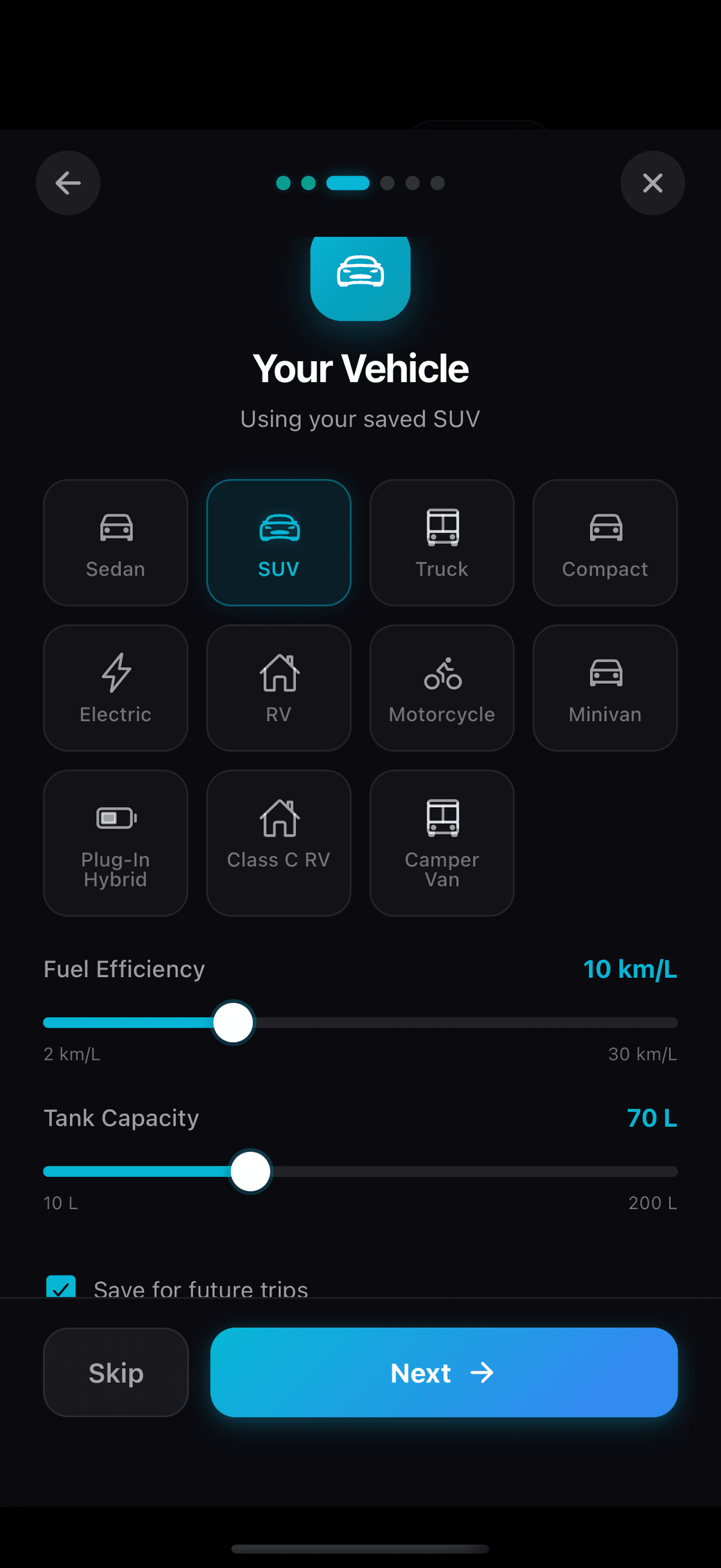

Every feature built specifically because RV travelers kept asking for it and no other app delivered.
Every tunnel and bridge on your route is checked against your RV's exact height, width, and weight. Get warned before you hit a low overpass, not after.
Grades over 6% are flagged with distance and elevation change. Critical for heavy rigs where brake fade and engine overheating are real risks on long descents.
Filter campgrounds by the hookups you actually need: 30 or 50 amp electric, water, sewer, full hookup, or dry camping. No more arriving to find out they only have 30 amp.
Not every gas station can fit a 40-foot Class A. Tourific filters for stations with pull-through lanes, high canopy clearance, and diesel pumps.
Find dump stations along your exact route, not just nearby. See hours, cost, and whether they have fresh water fill-up. Plan dumps around your travel days.
Class A, Class B, Class C, travel trailer, fifth wheel, camper van, truck camper. Each has different clearance profiles, turning radius concerns, and campsite requirements.

Tell Tourific your rig type, dimensions, and travel preferences. The AI builds routes that actually work for your specific vehicle. No more guessing whether your rig will fit through that tunnel or finding out at the entrance that it won't.
Real RV fuel costs. Real camping rates. Real clearance considerations for every route.
Chicago to Santa Monica
Flat terrain through the heartland. Plenty of RV parks with full hookups along the historic corridor.
Shenandoah to Cherokee
Steep grades and tight curves require careful planning. Some tunnels have low clearance for tall rigs.
San Francisco to Los Angeles
Big Sur has narrow sections with tight turns. Class A rigs over 35 feet should consider inland alternatives for some segments.
Boston to Burlington VT
Covered bridges have height restrictions. Book campgrounds by April for peak foliage season (late September to mid October).
Hard-won knowledge from experienced RV travelers. Each tip solves a problem most people learn the expensive way.
Measure from the ground to the highest point, including the rooftop AC unit, antennas, and any roof rack. Add 3 inches for tire inflation variance. Write this number on a card and tape it to your dashboard.
Before each state, download that state's DOT bridge clearance database. Caltrans, TxDOT, and most state DOTs publish this data. Tourific automates this, but having a backup never hurts.
Popular campgrounds, especially in national parks, fill their first-come-first-served spots by mid-afternoon. Plan your driving day to arrive between 2pm and 3pm. This also gives you daylight to level and set up.
A full fresh water tank adds 300 to 700 pounds depending on tank size. That extra weight matters on steep grades. Fill up after you descend, not before you climb.
Beyond dedicated propane dealers, many hardware stores (Ace, True Value), farm supply stores, and even some gas stations offer propane refills. U-Haul locations are another reliable option in most towns.
Extending slide-outs on an unlevel surface puts uneven stress on the slide mechanism and seals. Use a bubble level on the floor, adjust with leveling blocks or jacks, then extend your slides.
Gross Vehicle Weight Rating is the maximum safe loaded weight. With full water tanks, full fuel, passengers, food, and gear, you may be closer to the limit than you think. Weigh your rig fully loaded at a truck stop CAT scale ($15).
National park campgrounds like Yellowstone, Yosemite, and Grand Canyon open reservations exactly 6 months before the stay date. Set calendar reminders. These sell out within minutes on release day.
RV tire blowouts are the number one cause of RV accidents. A TPMS alerts you to slow leaks and overheating before a blowout happens. Monitor all tires including the tow vehicle and trailer.
RVs travel slower, need more fuel stops, and require longer to park and maneuver. A 350-mile day in a car becomes a full exhausting day in an RV. Build in buffer time for unexpected detours.
Yes. When you set up your vehicle profile in Tourific, you enter your RV's height, width, and weight. The app then checks every bridge, tunnel, and overpass on your route against those dimensions. If any structure has insufficient clearance, you get a warning with an alternative route suggestion.
Tourific supports Class A motorhomes, Class B camper vans, Class C motorhomes, travel trailers, fifth wheels, truck campers, and converted vans. Each type has its own clearance profile and the app adjusts campground recommendations based on your rig's size and hookup needs.
When planning a route, Tourific filters campgrounds by the hookups you need: 30 amp electric, 50 amp electric, water, sewer, or full hookup. It also factors in your rig length to ensure the site can accommodate you. Results are sorted by proximity to your route and user ratings.
RV fuel costs are typically 3 to 8 times higher than a sedan due to lower MPG (8 to 15 MPG for most RVs vs 25 to 35 MPG for cars). However, you save significantly on accommodation by camping ($28 to $120 per night vs $150 to $450 for hotels). For a 14-day Route 66 trip, expect roughly $680 in fuel and $500 to $1,560 in camping fees.
Yes. Tourific maps dump stations along your planned route, not just within a radius of your current location. Each listing includes hours of operation, cost (many are free at campgrounds), whether fresh water fill-up is available, and user reviews. You can plan dump stops as part of your daily itinerary.
Clearance checks, campground matching, grade warnings, dump stations, and RV-specific cost estimates. All in one app.