Home/EV Road Trips
Electric VehiclesCharging PlannerRange SimulationAI-Powered

The Complete EV Road Trip Planner

Range anxiety is a planning problem, not a battery problem. Tourific simulates your EV's state of charge across every mile so you always know where to charge, how long it takes, and what it costs.

50+
EV-Optimized Routes
SoC per Leg
Simulation
CCS1 / NACS / CHAdeMO
Connectors
Non-Linear
Charging Curves
The Challenge

Why EV Road Trips Are Different

Gas cars have a simple equation: fill up in 5 minutes, drive 400 miles, repeat. EVs add four variables that most planning tools ignore entirely.

Range anxiety

Tourific simulates your exact SoC at every waypoint. You see 47% battery at Monterey, not a vague range circle.

Charging infrastructure gaps

Tourific maps every CCS1, NACS, and CHAdeMO station on your route and filters to your connector type. No wrong-plug surprises.

Non-linear charging curves

Charging 10-80% takes 25 min. 80-100% takes 40 min. Tourific uses real charging curves to give accurate wait times, not best-case marketing numbers.

Weather impact on range

Cold weather can slash range 20-40%. Tourific adjusts SoC projections based on ambient temperature along your route and time of year.
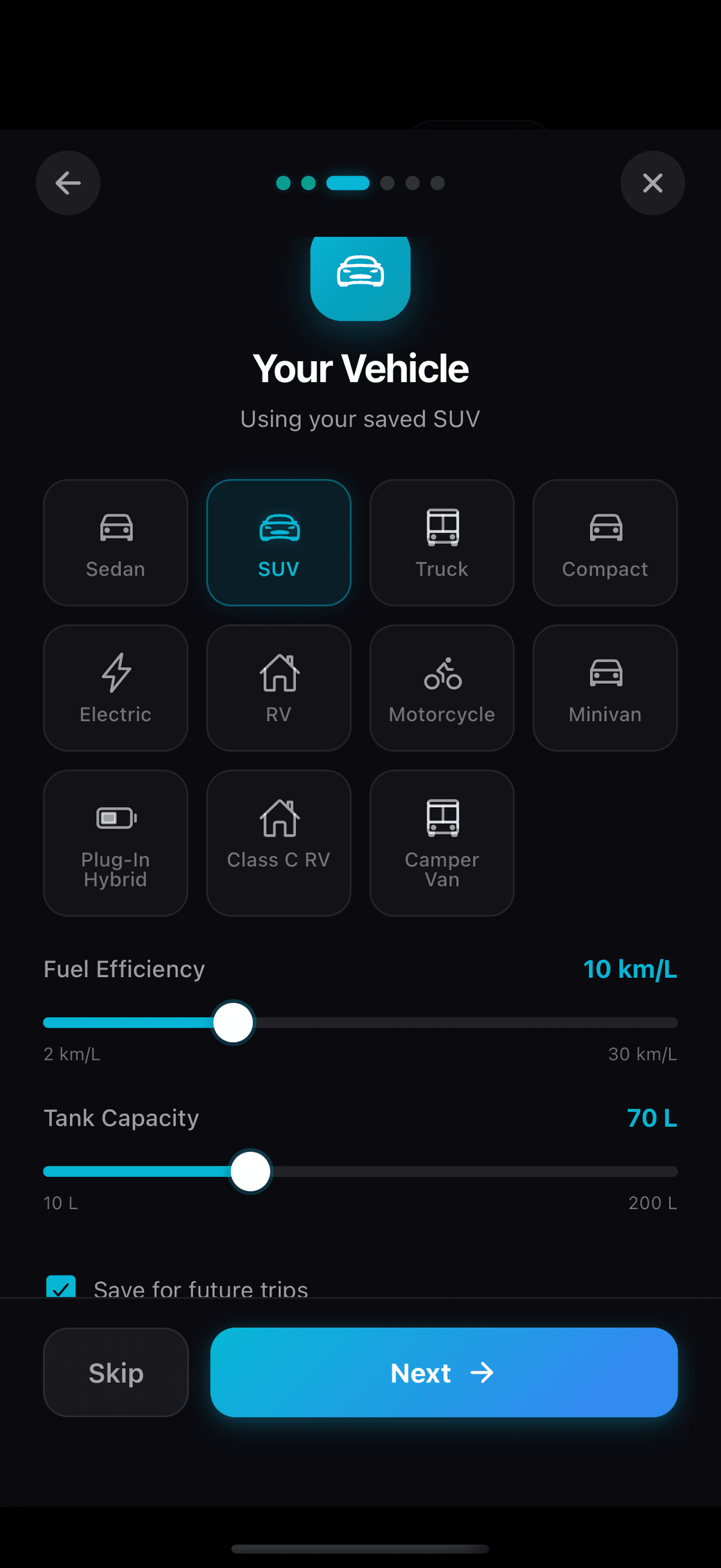
Tourific EV vehicle preferences showing battery capacity, connector type, and efficiency settings
How It Works

How Tourific Plans Your EV Road Trip

Four steps from route idea to a fully optimized charging plan with realistic time and cost estimates.

01

Enter your EV specs

Battery capacity in kWh, connector type (CCS1, NACS, or CHAdeMO), and your vehicle's rated efficiency. Tourific has presets for popular models like Tesla Model 3, Ioniq 5, Mach-E, and 40+ others.

02

AI simulates state-of-charge across every leg

Tourific runs a SoC simulation on your entire route, factoring in elevation profile, average speed, ambient temperature, and HVAC usage. You see your projected battery percentage at every waypoint.

03

Optimal charging stops placed at 15% threshold

When your projected battery drops to 15%, Tourific places a charging stop at the nearest compatible fast charger. It picks stations near restaurants, rest areas, or attractions so you are never just sitting and waiting.

04

Real cost and time estimates per stop

Each charging stop shows estimated cost (based on network pricing), charge time (using non-linear curves), and target SoC when departing. You see the total trip charging cost and total charging wait time before you leave home.

Try EV Planning Free
Only on Tourific

EV Features No Other App Has

Most EV planners show you range circles and charger pins. Tourific actually simulates your battery.

🔋

State-of-Charge Simulation

Not range circles. Actual SoC percentage at every waypoint, accounting for speed, elevation gain, HVAC load, and cargo weight. You see exactly what battery you will have when you arrive.

📈

Non-Linear Charging Curves

Charging 0-80% takes 25 minutes. 80-100% takes another 40. Tourific models your car's actual charging curve so time estimates are realistic, not optimistic.

❄️

Cold Weather Range Reduction

Winter driving can cut EV range by 20-40%. Tourific factors in ambient temperature along your route so you are not stranded in a January storm with 5% battery.

🔌

Connector Type Matching

CCS1, NACS, CHAdeMO. Tourific filters charging stations to your car's connector. No more arriving at a station only to find the wrong plug type.

💰

Charging Cost Estimates

Per-station cost estimates based on network pricing (Electrify America, Tesla Supercharger, ChargePoint). Know exactly how much each stop will cost before you leave.

⏱️

Charging Time Predictions

Based on your arrival SoC and the charger's max output, Tourific predicts how long you will sit at each stop. Plan meals and rest breaks around charging, not the other way around.

Curated Routes

Best EV Road Trips

Every route has been verified for EV charging coverage. Costs shown are for DC fast charging a 75 kWh battery.

🌊EV Verified

Pacific Coast Highway

San Francisco to Los Angeles

615 km
EV Charging: $42View Guide
🌴EV Verified

Florida Keys

Miami to Key West

260 km
EV Charging: $18View Guide
🏔️EV Verified

Blue Ridge Parkway

Shenandoah to Cherokee

755 km
EV Charging: $48View Guide
🍂EV Verified

New England Fall Foliage

Boston to Burlington VT

520 km
EV Charging: $38View Guide
🏜️EV Verified

Canyon to Canyon

Grand Canyon to Zion

480 km
EV Charging: $34View Guide
View All 50+ EV Routes in App
Expert Tips

EV Road Trip Tips

Practical advice from thousands of EV road trips planned through Tourific.

01

Pre-condition your battery before long drives

Most EVs let you warm or cool the battery while still plugged in. This uses grid power instead of battery power and gives you full range from the start. On a Tesla, enable "Scheduled Departure" 30 minutes before you leave.

02

Plan charging stops during meals

A DC fast charger takes 25-40 minutes for a meaningful charge. That is exactly one lunch or coffee stop. Tourific places charging stops near restaurants so you are eating, not waiting.

03

Keep battery between 20-80% for fastest charging

DC fast charging slows dramatically above 80% SoC. Charging from 80-100% can take as long as 10-80%. Plan shorter, more frequent charges in the sweet spot instead of topping up to 100% each time.

04

Download offline maps before departure

Some charging stations are in areas with no cell service, especially along rural highway corridors. Download your full route in Google Maps or Apple Maps offline before leaving. Also save charger locations in your car's built-in nav.

05

Check charger status before committing to a stop

Broken chargers are the number one frustration for EV road trippers. Check PlugShare or the charging network's app (Electrify America, ChargePoint) for real-time status 15 minutes before arriving. Tourific flags stations with reliability issues.

06

Account for elevation gain reducing range

Climbing 1,000 feet of elevation can cost 3-5% of battery on a typical EV. A mountain pass route like I-70 through the Rockies (Eisenhower Tunnel at 11,158 ft) can consume 20%+ more than the flat-road estimate. Tourific adjusts for this automatically.

07

Winter trips: expect 20-30% less range

Cold batteries accept and deliver less energy. Heating the cabin is a significant drain (unlike gas cars that use waste engine heat). Use seat heaters instead of cabin heat when possible. They use 75W versus 3,000-5,000W for the climate system.

08

Book hotels with Level 2 chargers

Overnight Level 2 charging (240V) adds 30-40 miles per hour. After 8 hours of sleep, you wake up with a full battery and skip your first fast-charging stop entirely. Filter hotels by EV charging on booking sites, or check PlugShare for hotels with J1772 stations.

09

Reduce speed on highway stretches

EV energy consumption increases exponentially with speed. Driving 65 mph instead of 75 mph can extend your range by 15-20%. On long highway legs between chargers, slowing down by 10 mph can mean the difference between comfortable arrival and range anxiety.

10

Use regenerative braking on hilly terrain

Set regen braking to maximum on mountain descents. A 3,000-foot descent can recover 8-12% of battery. On routes like the Blue Ridge Parkway, the constant elevation changes actually help EVs. You lose range going up but recover a significant portion coming down.

Other apps show range circles.
We simulate every mile.

FAQ

EV Road Trip FAQ

Yes. The DC fast charging network in the US now covers all major highway corridors. A modern EV with 250+ miles of range and CCS1 or NACS charging can complete any route that a gas car can. The key difference is planning: you need to know where chargers are and how long each stop takes. Tourific handles this automatically by simulating your state of charge across every leg.

Tourific takes your battery capacity (in kWh), your vehicle's efficiency (Wh/mi), and your connector type, then simulates state of charge across every leg of your route. It factors in elevation changes, speed, ambient temperature, and HVAC load. When your projected SoC drops to 15%, it places a charging stop and estimates charge time using non-linear curves (fast to 80%, slow to 100%).

EVs with 270+ miles of real-world range and access to fast charging networks perform best. Tesla Model 3/Y with the Supercharger network remains the easiest for road tripping. The Hyundai Ioniq 5 and Kia EV6 charge from 10-80% in 18 minutes. The Ford Mustang Mach-E and Chevy Equinox EV are strong options with CCS1. The Rivian R1S is excellent for adventure routes with less charging infrastructure.

DC fast charging typically costs $0.35-0.48 per kWh, depending on the network. A full charge on a 75 kWh battery costs roughly $26-36. For comparison, a 4-day Pacific Coast Highway trip costs about $42 in EV charging versus $85 in gasoline for a 30 MPG car. Tourific estimates per-stop charging cost based on the specific network and your battery's needs at that point.

Broken chargers are a real concern. Tourific addresses this by never routing you with less than 15% battery at arrival, giving you buffer to reach an alternate station. The app also shows multiple nearby chargers at each stop so you have a backup plan. We recommend checking real-time charger status on PlugShare or the network's own app 15 minutes before arriving at any charging stop.

Plan Your EV Road Trip

State-of-charge simulation, optimal charging stops, real cost estimates. The only EV planner that actually knows your battery.